

Bible Beehive is a collaborative web tool for Bible translation teams. It is particularly aimed at teams in difficult contexts targeting languages where there is no existing Bible translation, and where users may struggle with more advanced software like Paratext.
My team and I are working in the developing world to produce a new translation of the New Testament in a language where almost no Bible resources exist. Because we could not find Bible translation software that met our needs, we developed our own, with the working title of "Bible Beehive". As the team worked through the translation of the NT over three years, the software was continually developed and improved. We now want to share this software with other Bible translation teams.
We are working in a context which makes it difficult for us to share our identities publicly. We are a team believers in the Lord Jesus, we are on the ground, and we are working in partnership with a well-known and trusted Bible translation organisation. The software itself was developed by one person on the team with programming abilities. Please contact us if you want to know more about us.
Here you go:
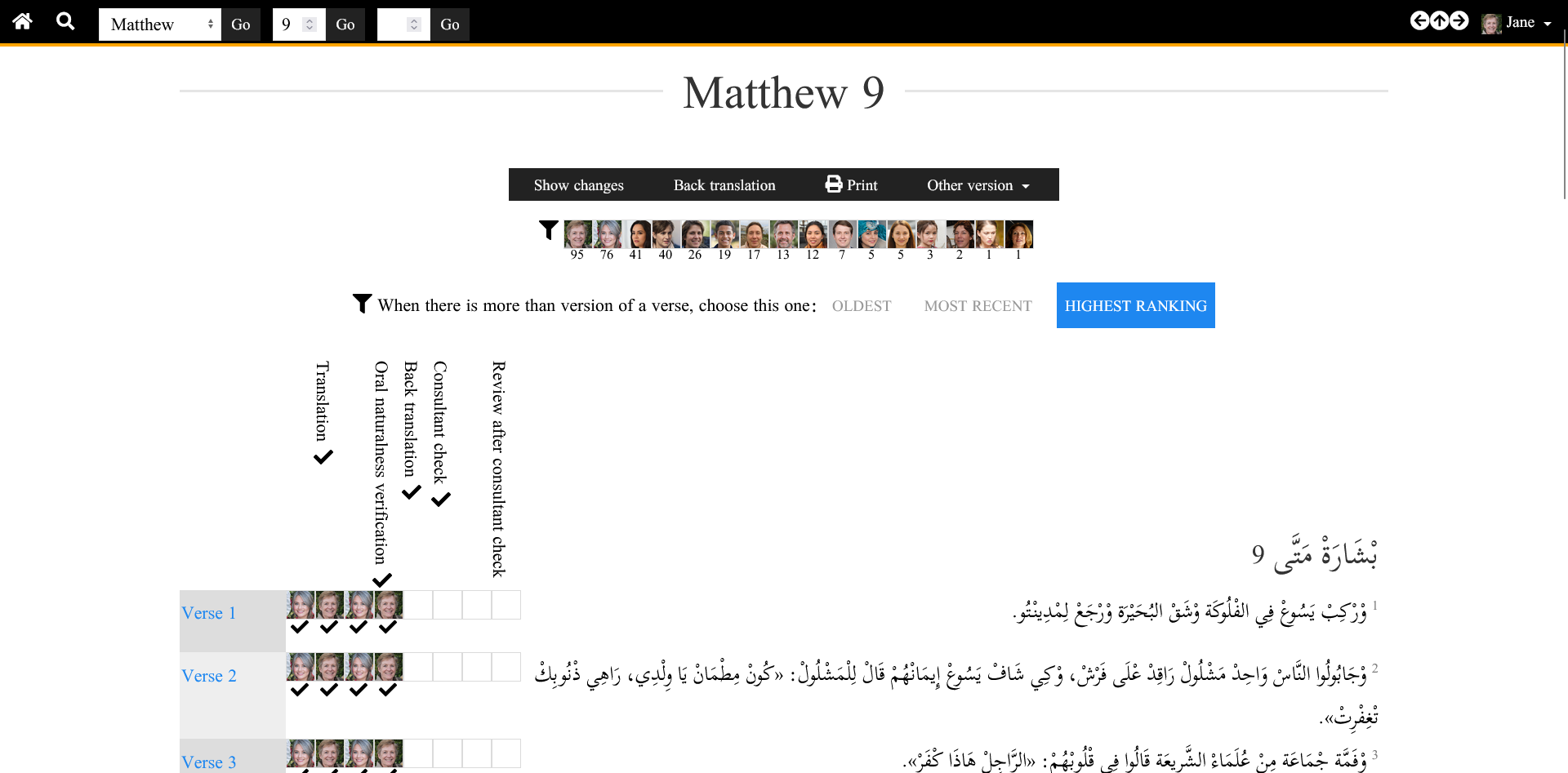
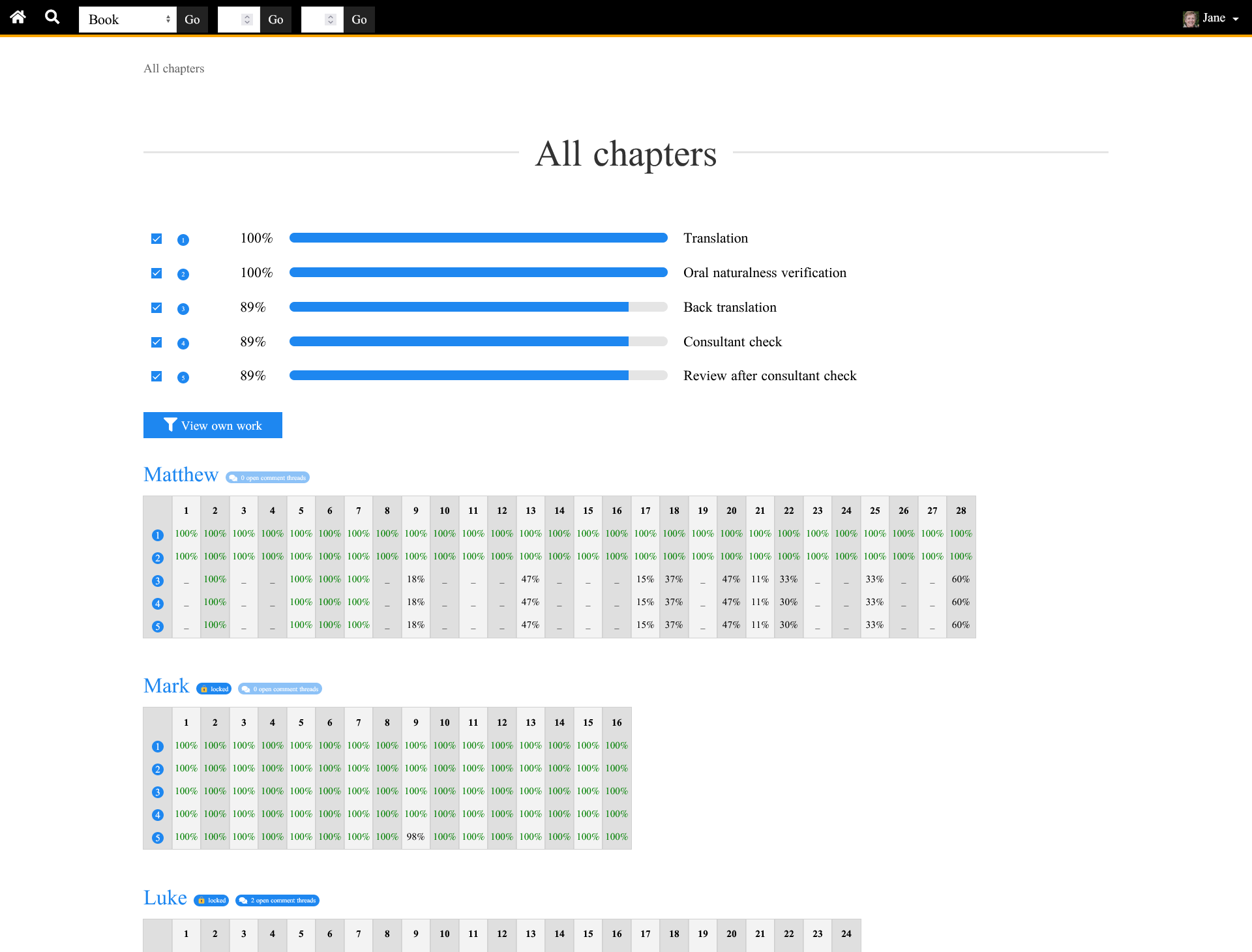
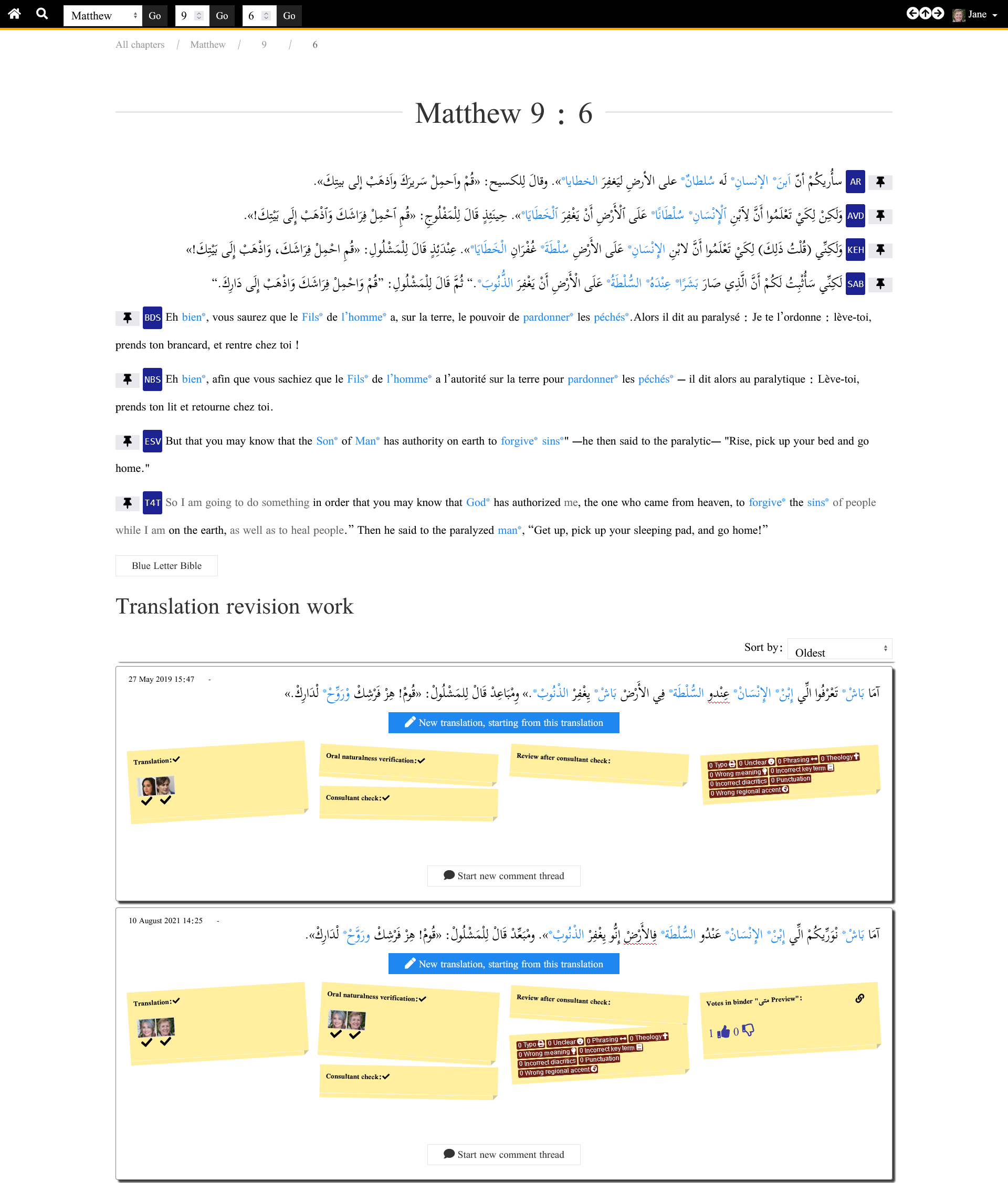
Bible Beehive has many features already! In summary, it has: comments, back translation, consultant review, key word highlighting, mandatory peer review, recruiting features, community testing features, simple progress tracking, and the ability to export to Paratext.
Paratext is a very powerful piece of software, much more powerful than Bible Beehive. If you are happy with Paratext, and if you are confident that your team will be able to learn Paratext, you should probably use Paratext instead of Bible Beehive.
| Bible Beehive | Paratext | |
|---|---|---|
| Platform | The web (Windows, macOS, Linux, iPhone, Android, etc.) |
Windows |
| Mandatory peer review | Yes, every verse must be approved by at least two users | No, the last user to edit has the final word. |
| Free from merge conflicts | Yes | No, users need to learn to handle merge conflicts |
| Share drafts online | Yes, using a simple website that gathers private feedback | Possible with additional tools, but more complicated and requires sign-up |
| Text format | Plain text (easy to use) | USFM (more powerful) |
| Intended users | Technophobes and beginner translators in difficult contexts, as well as consultants | Wide audience of translators and consultants, both experts and non-experts |
| Complexity of interface | Simple. Like many websites. No training needed. | Complex. Training often required. |
| Offline mode | No | Yes |
| Integrated resources | Hardly any | Wide selection of Bible translations and resources |
| Number of features | Some | Many |
| Userbase | One team so far | Many teams around the world |
| Availability | Not yet released to the public, private beta only | Available to be downloaded now |
| Licensing | Open source | Proprietary |
| Price | Free to share because it is open source. Hosting is not included. | Free |
Bible Beehive is built using Python, Django, PostgreSQL, and Vue, alongside the standard web technologies (HTML, CSS, Javascript).
This will entirely depend on the needs of its users, so please get in touch! I personally would like to make it integrate better with Paratext.
This is just a working title, and it may be changed in the future. The name of beehive is meant to invoke the idea of collaboration.
Yes, please tell us if you are interested in this project! Would it serve your needs? What would you need in Bible translation software?
Contact us using this contact form.
Please fill in the contact form and make sure to indicate that you want to receive updates over email.
Bible Beehive is currently being used by one team. If you would like to use it too, or to try it out, please let me know by contacting me.
Yes, Bible Beehive is open source, according to the Open Source definition. It also free (as in freedom) software according to the Free Software Foundation. To request a copy of the source code, use the the contact form.
Since Bible Beehive is open source and free/libre, it can be redistributed free of charge.
So far, Bible Beehive was developed just for the needs of one particular team. I am trying to discover if there is a need for this software outside of our team. If there is, then we would invest more in this software and we would look for ways to make its development sustainable. This may mean entail charging for the software (while remaining open source), or it may mean applying for grants, or alternatively, forming a community of volunteers motivated in part by open source values. I'm not sure which will be the best path forward, so please contact me and help me figure this out!
This website was launched on 25 May 2022 and was last updated 14 Sept 2022.